
Baby & children
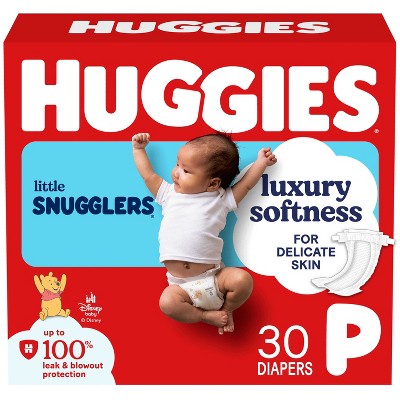
Huggies Little Snugglers Diapers - Preemie - 30ct
Huggies · owned by Kimberly-Clark Corporation
Infant skin is thinner and more permeable than adult skin, with a higher surface-area-to-weight ratio, so the same product delivers a proportionally larger dose. The American Academy of Pediatrics advises fragrance-free, dye-free products for routine infant care.
Chemistry breakdown
Bar length = weight in the Baby & children formula · color = that component's score · tap a name to learn what it means.
Scored from 52% of the formula's weight. The rest doesn't apply to this product.
Fragrance allergensno fragrance listed · 28% weight
Fragrance in a product worn against covered, often irritated skin for hours at a time — close to worst-case conditions for a contact allergen. The French safety agency ANSES recommended eliminating fragrance from diapers entirely, and two once-common diaper fragrance allergens are now banned in EU cosmetics. Fragrance-free isn't a preference here; it's the evidence-backed choice.
Migrating additives5.9/10 · 24% weight
Substances that can move from the product onto skin: hot-melt adhesives and their tackifier resins, printed pigments, and the lotion applied to the liner. Rated per substance — most are low-concern, but this is where quality differences between makers actually show up.
Skin-contact materials6.3/10 · 18% weight
The fibres and films against the skin — fluff pulp, cotton, polypropylene, the absorbent polymer. Reassuringly, this is the part of a diaper with the strongest safety record: these polymers aren't absorbed through skin. A good score here is expected; the real questions live in the other components.
PFASno PFAS listed · 12% weight
Per- and polyfluoroalkyl substances — 'forever chemicals' that persist in the body and environment for years. Used for water- and stain-resistance; linked in studies to immune and developmental effects.
Certifications6/10 · 10% weight
Independent third-party verifications (USDA Organic, FSC, EPA Safer Choice…). Informational only — having none never lowers a score; verified claims can raise it.
Process residuesno residue data — panels never carry it · 8% weight
What manufacturing leaves behind rather than what goes in: the pulp-bleaching route (totally-chlorine-free vs chlorine-dioxide), residual monomer in the absorbent polymer, trace PAHs. French agency testing found these — not the plastics — were where diaper risk thresholds were exceeded. Rarely disclosed on any panel, so this mostly scores through process certifications.
Materials · 30
A bill of materials, not a recipe: the maker lists components by amount, and the bulk of a diaper is inert structure. Scoring here weighs every material equally — what matters most (fragrance, adhesives, process residues) is usually at the bottom of the list or not on it at all. Tap any row for its sources.
- 6Polypropylene (Nonwoven Fabric)#1 · Structural polymer
- 8Cellulose#2 · Fiber
- 6Sodium Polyacrylate (Superabsorbent Polymer)#3 · Structural polymer
- 6Polyethylene#4 · Structural polymer
- 6Polyester#5 · Structural polymer
- 6Hydrocarbon resin/resine hydrocarbonee#6 · Adhesive / resin
- 8Calcium Carbonate#7 · Personal Care Active
- 6Styrene/butadiene copolymer#8 · Adhesive / resin
- 3Titanium Dioxide (food grade)#9 · Colorant
- 6Spandex (Elastane)#10 · Structural polymer
- 6Styrene/so- prene copolymer#11 · Adhesive / resin
- 6Mineral Oil (cosmetic grade)#12 · Personal Care Active
- ?Propylene glycol propyl ether#13 · Whole Food
- ?Calcium oxide#14 · Whole Food
- ?Oleyl palmitamide#15 · Whole Food
- ?Peg-10 hydrogenated castor oil#16 · Whole Food
- ?Sorbitan oleate#17 · Whole Food
- 6Pigment black 7#18 · Pigment / ink
- 6Pigment blue 15#19 · Pigment / ink
- 5Pigment yellow 14#20 · Pigment / ink
- 6Pigment red 254#21 · Pigment / ink
- ?Potassium dodecyl phosphate#22 · Whole Food
- 5Pigment red 52:1#23 · Pigment / ink
- 5Pigment red 57:1#24 · Pigment / ink
- ?Peg-15 cocoate#25 · Whole Food
- ?Deceth 4 phosphate#26 · Whole Food
- ?Diethylhexyl sodium sulfosuccinate#27 · Whole Food
- ?Sorbitan laurate#28 · Whole Food
- ?Peg-10 castor oil#29 · Whole Food
- ?Potassium stearyl phosphate#30 · Whole Food
Made by
- 2017Bahamas Surgery Center v. Kimberly-Clark — California federal jury found K-C misrepresented MicroCool surgical gowns as impermeable; award later reduced on appeal to roughly $25M. The surgical products business was spun off as Halyard/Avanos.